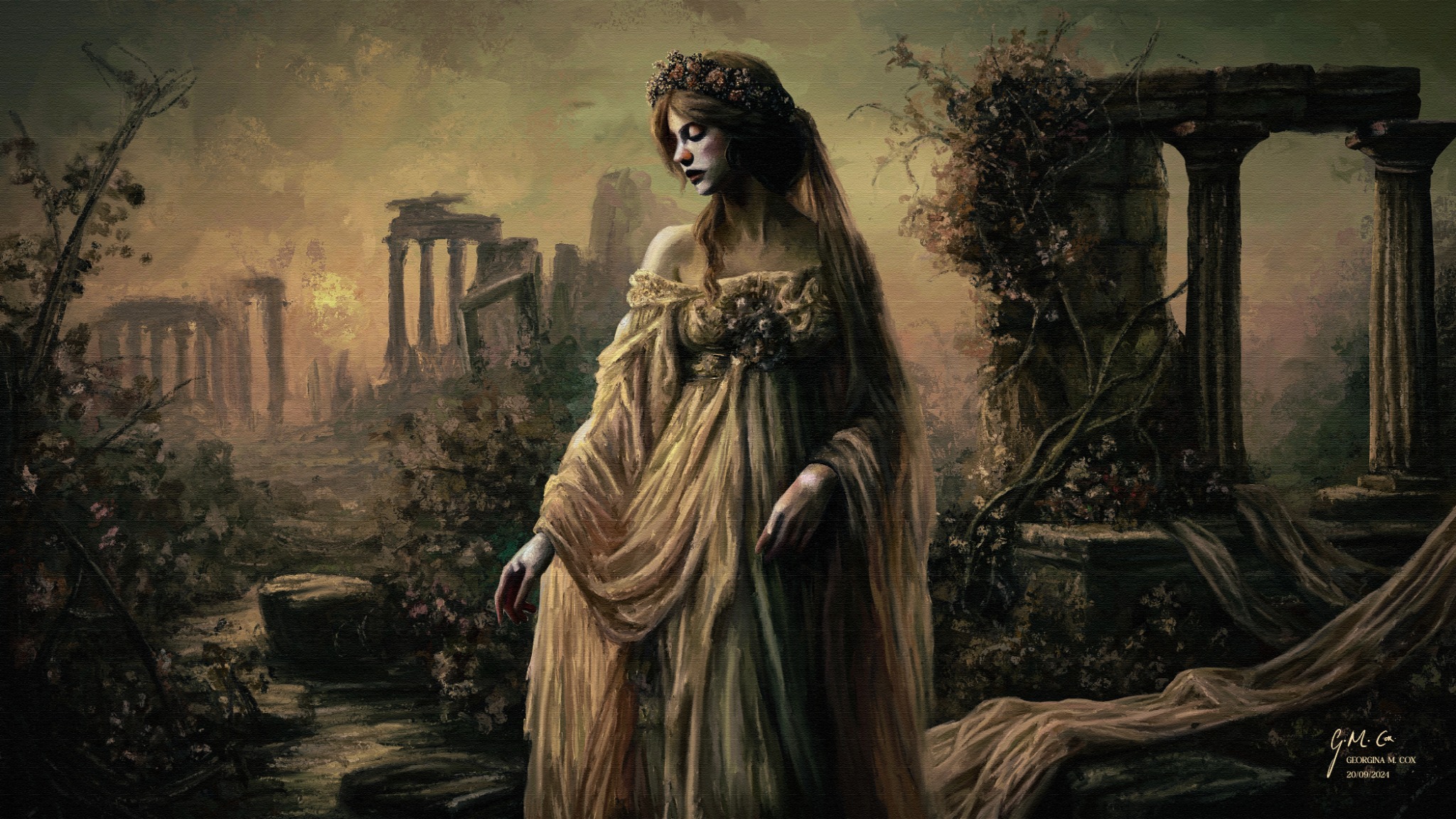
Fantasma (2024)
Fantasma unfolds like a memory that refuses to fade. A lone woman wanders through the ruins of a forgotten world, her golden gown blending with the last light of dusk. Vines reclaim the marble columns around her, their decay softened by flowers and shadows. Her downcast eyes and faintly luminous skin suggest she is not of the living, but of what remains, a remnant haunting the threshold between history and dream.
⤷ Cox reimagines the classical ruin as a site of mourning and rebirth. The crumbling architecture speaks not only to empire and time but to the fragility of memory itself. The spectral figure, poised with quiet grace, could be an echo of a lost goddess or the embodiment of the land’s decay. The palette, muted golds, greens, and ashes, creates an atmosphere of tender entropy. Every surface seems to breathe its own exhaustion.
The title, Fantasma, evokes both ghost and reverie. This is not a painting of death, but of persistence: beauty lingering after purpose, presence after power. In many ways, it feels like a love letter to the ruins—the way light still finds its way through what’s been broken.
0 Comments Add a Comment?